

Blockchain-Backed Integrity
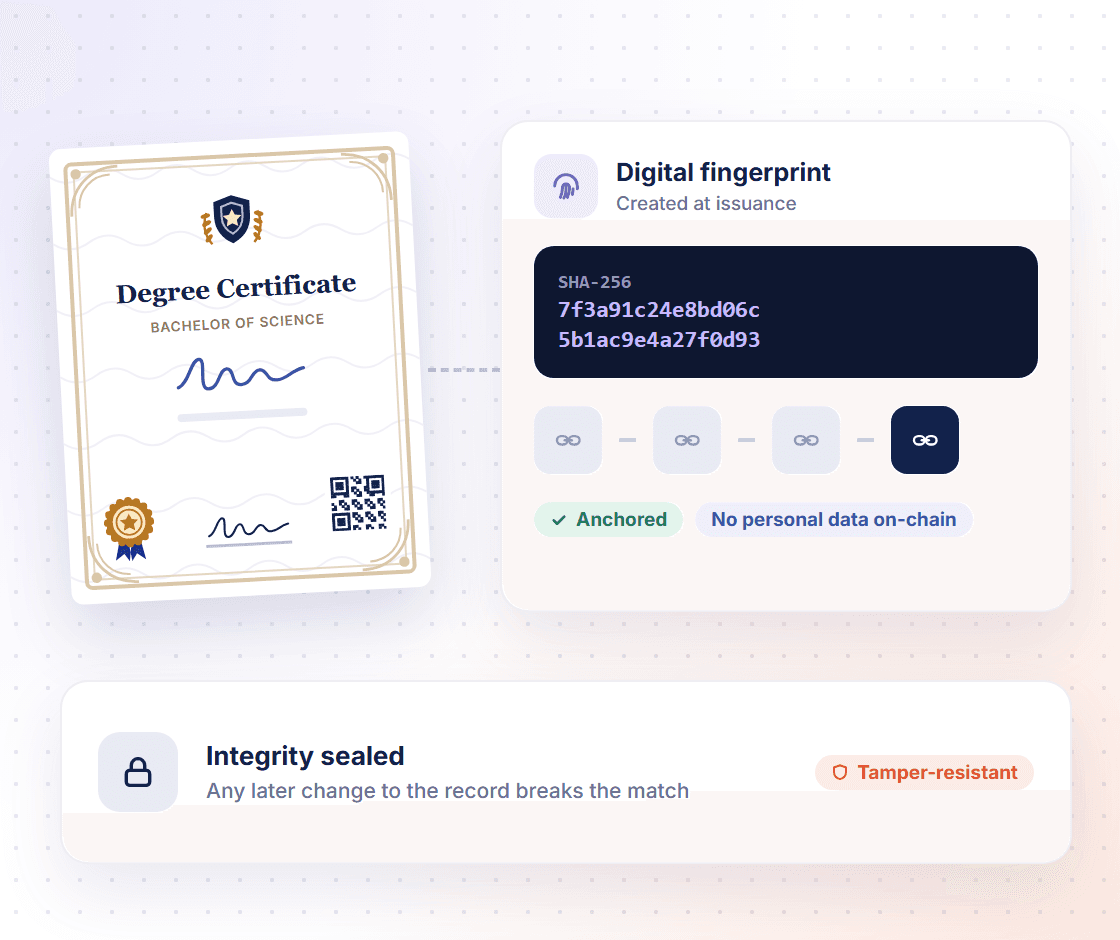
A fingerprint of every record is anchored on the blockchain.

Tamper-Resistant Records
Any change to a credential no longer matches its record.

Unique Credential IDs
Each credential carries its own ID, tied to one record.

QR-Based Verification
Anyone can scan and confirm a credential in seconds.

Digital Signatures
Authorised signatures and seals are applied to every credential.

Secure Access Controls
Only authorised people can issue or change credentials.

TruScholar helps institutions guard against

Fake certificates
Altered academic records
Credential duplication
Slow manual verification
Lost physical documents
Hard cross-border checks


Trusted, unchangeable record
No personal data on-chain
Instant integrity check




Altered names
Modified grades
Changed credential dates
Forged certificates
Duplicate credentials
Unauthorised modifications

QR Code
Scanned from paper or screen

Verification Record
Held by the issuer
Credential Data
Learner, issuer and dates
Integrity Check
Matched on the blockchain


Digital Credentials
Protect credentials shared as PDFs, wallets or online records, each with built-in verification.


Physical Certificates
Printed certificates carry QR verification, so authenticity can still be checked after printing.

Role-based access control
Maker, checker and approver workflows
Authorised issuance only
Secure authentication with single sign-on
Append-only audit trails
Complete issuance history
Controlled credential management

01
Design
Approved, locked templates

02
Data Import
Every row validated

03
Issuance
Authorised and approved

04
Delivery
Sent to the right recipient

05
Storage
Protected, access-controlled records

06
Sharing
Verifiable wherever shared

07
Verification
Checked against the blockchain
ISO/IEC 27001
SOC 2 Type II
CMMI Level 3
GDPR aligned

Data Protection
Credential data is encrypted and held on certified infrastructure.

Privacy Controls
Only a fingerprint goes on-chain, never any personal data.

Access Management
Granular roles keep every action in the right hands.

Auditability
An append-only log records every action for review.

For Institutions
Protect institutional reputation and reduce credential fraud.

For Learners
Store and share credentials with complete confidence, anywhere.

For Employers and Verifiers
Confirm credential authenticity quickly, without chasing the issuer.

How does blockchain secure digital credentials?
When a credential is issued, a unique digital fingerprint (a cryptographic hash) of its record is anchored on the blockchain. Verification compares the credential with that fingerprint, so any change to the record is detected. No personal data is written on-chain.
Are TruScholar certificates tamper-proof?
How can a certificate be verified?
How does QR code verification work?
Can physical certificates be verified?
What happens if credential information is changed?
Authorised changes made by the issuer are recorded in the audit trail and reflected in the verification record. Unauthorised changes to a copy will not match the trusted record.